Once the course materials, project kits and VR environments have been developed, they need to be tested and refined based on what actually works. This is the focus of Work Package 3, coordinated by our Romanian partner at the Universitatea din Oradea.
"This work package is where the project moves from design into practice: courses are delivered with student teachers, VR environments are used in live sessions, project kits are piloted in partner schools, and professional development webinars reach in-service teachers across Europe."
eTwinning ITE Courses
At the heart of this output are the eTwinning-based virtual exchange courses delivered across all five partner institutions. Each partner runs the course two to four times over the course of the project, involving groups of pre-service teachers who collaborate internationally, develop eTwinning School Project Kits on cultural heritage themes, and create immersive VR learning environments. Across all partners and course cycles, the project aims to reach a total of approximately 150 student teachers.
Course cycles completed so far include runs at Ludwigsburg (Summer 2025, Winter 2025/26, Summer 2026), the University of Crete (Summer 2025), Tallinn University (Summer 2026), Gordon Academic College of Education (Summer 2026) and the Universitatea din Oradea (Summer 2026).
One of the defining features of eTACCHE is that it is not five separate courses running in parallel — it is one shared course concept, delivered simultaneously across partner institutions and brought to life through structured international collaboration between student teachers.
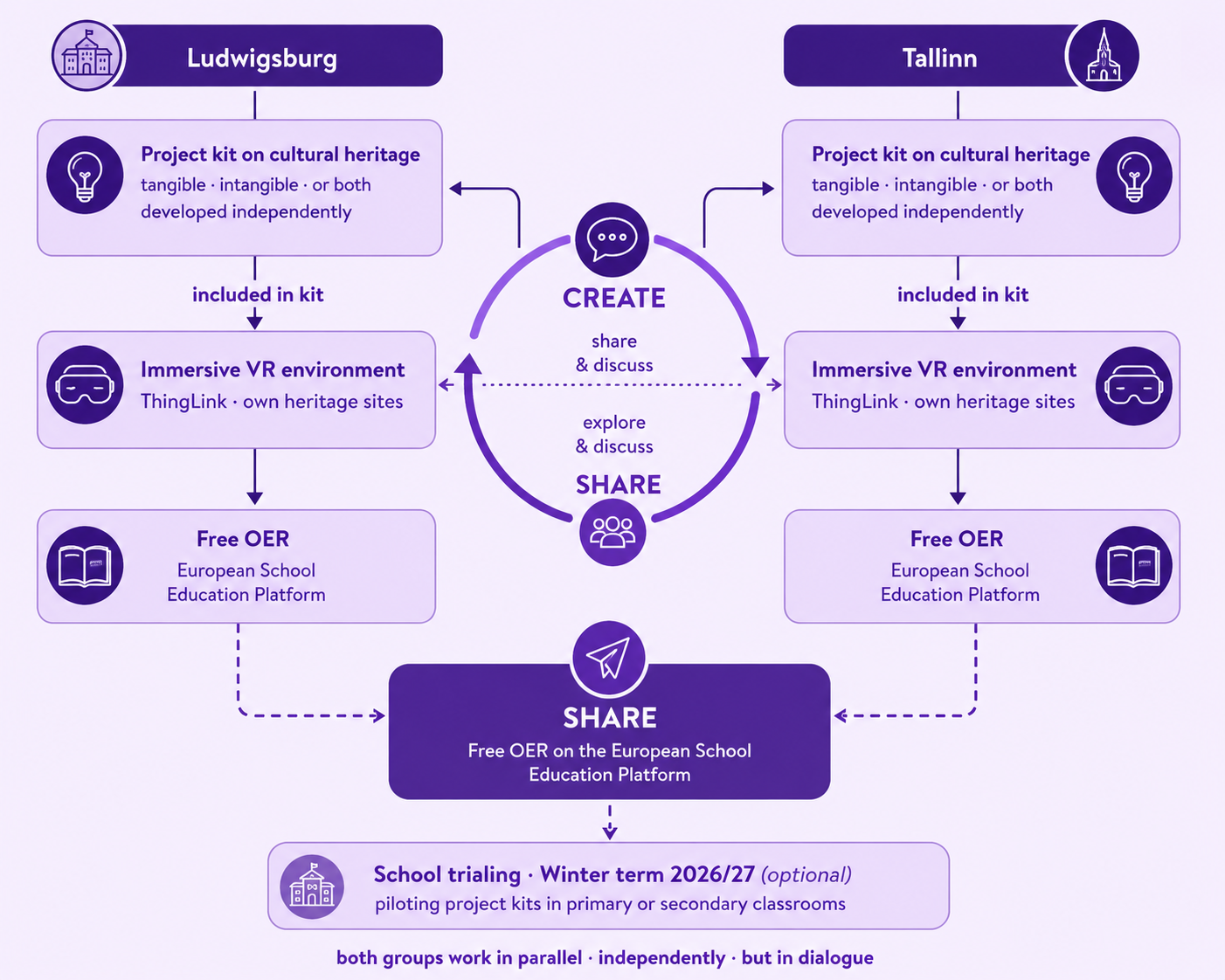
The five partner institutions work in two collaborative groups: Group 1 brings together Ludwigsburg, Tallinn and Crete. Students from all three institutions collaborate in international groups, with joint virtual exchange sessions. Group 2 pairs Oradea and Haifa, with joint session.
To ensure quality and consistency across institutions — and to build a shared resource that outlasts the project itself — all partner institutions systematically collect and share course documentation throughout the project. This includes syllabi, seminar programmes and session plans, reading lists and assessment criteria, student assignments and project outputs, teaching materials and presentation slides, documentation of digital tools used (including VR and AI activities), attendance lists, photos and screenshots, evaluation forms, and reflection reports from both lecturers and students.
All materials produced across the project are progressively made available as Open Educational Resources, freely accessible to educators and institutions worldwide.
Immersive Environments
Throughout the course cycles, students and teacher educators test and refine the immersive VR environments developed in WP2. Environments are used in both university seminars and virtual exchange settings, and are iteratively improved based on pedagogical feedback and usability experience. The goal is a finalised set of freely accessible VR environments, each meaningfully linked to a project kit and ready for use by schools and teacher education programmes beyond the project.
School Implementation
From November 2026, the project kits developed by student teachers move into real school classrooms. Each partner institution establishes international school tandems — pairing schools from two different countries around a shared project kit — and supports teachers and pupils through a focused implementation phase of up to four weeks per kit. Feedback from teachers and pupils feeds directly into the final revision of the kits before their publication as Open Educational Resources.
Webinars
Alongside the university courses, the project delivers a series of professional development webinars for practising teachers. Each partner institution contributes two webinars — covering topics such as the pedagogical use of eTwinning, immersive technologies in cultural heritage education, and inclusive digital pedagogy. Webinars are recorded and will be made available in all five partner languages.